Action on the Ground
AOG Project Summary
Carbon & my business – a dilemma needing facts?
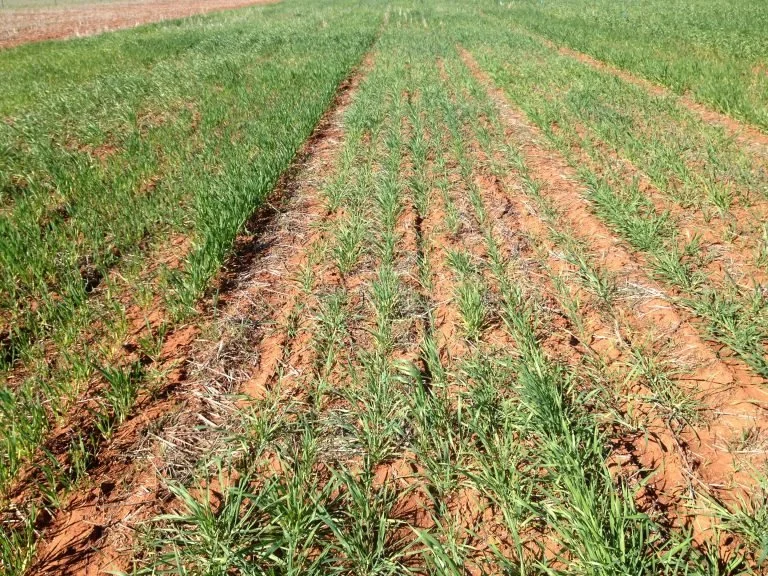
The importance of soil organic carbon to soil health and sustainable agriculture has been recognised by farmers and scientists for many years. The role of soil organic carbon in the emerging carbon economy is less well understood. There is a critical need for scientifically based data on the relationship between soil carbon and profitable farming system design. Without this datafarmers cannot make sense of the many, often confusing, claims about opportunities in the emerging carbon future.
CWFS research aims to provide practical opportunities and research results for members. This will allow for informed decisions about farm business design into the future.
For further information please contact James Mwendwa on (02) 68 951 050 or mobile 0427 951 050.
This project is supported by funding from the Australian Government Department of Agriculture, Fisheries & Forestry as part of its Carbon Farming Futures – Action on the Ground program.
Project title: The impact of farming systems on soil carbon and health in a dry land cropping zone
Project term: 15 June 2012 – 30 June 2015
Project Background information
A great window of opportunity exists for a detailed study of a long term farming systems trial established in 1998 in the dry cropping zone of central New South Wales. The farming systems comparison trial on the Condobolin Agricultural Research and Advisory Station (ARAS) investigated the management, profitability and sustainability of four farming systems on 160 ha. The extensive trial was widely replicated to meet the needs of both research and farmers. Local farmers had input into the trial treatments ensuring the treatments imitated a true representation of localised farm management practices for extension purposes.
The four systems described below were replicated four times with every rotational phase within each system present in each year. Each of the five plots across all cropping systems in each replicate was approx. 2 ha. The systems were:
Traditional (mixed farming) system – The five-year rotation consisted of long fallow wheat (LFW), followed by short fallow wheat undersown (SFWu/s) with a lucerne/clover/medic-based pasture, then three years of grazed pasture.
Reduced tillage including livestock (mixed farming) system – This system grew all wheat crops on long fallow. The rotation was long fallow wheat (LFW), skip a year (stubble maintained, weeds controlled by grazing and a chemical application in August), long fallow wheat undersown (LFWu/s) with a lucerne/clover/medic-based pasture, then two years grazed pasture.
No tillage, no livestock (continuous cropping) system – This system was reliant on chemicals only for weed control. The five-year cropping rotation was canola, wheat (SFWaC), pulse, wheat (SFWaP) and a green manure crop. This system represented a significant intensification of cropping in this district and no perennial species were included in the system.
Perennial pasture system – Each replicate in the perennial pasture system was approximately 10 ha and was divided into 12 equal-sized segments radiating from a central watering point. Sheep were rotationally grazed with half-weekly intervals on each segment.
This farming systems comparison trial is still running with data being collected for different projects based on trial objectives. Therefore, it provides an ideal opportunity to collect data measurements to assess soil carbon sequestration and soil structural information; including infiltration, nutrition and soil water storage capacity. Based on the long-term history of the trial site there could be valuable soil data for regional and national benchmarking backed by detailed paddock and economic records to interpret the soil health results.
Project Description
The project will trial and demonstrate four innovative on-farm farming systems to increase the sequestration of carbon in soil by using traditional cropping-grazing, reduced tillage cropping -grazing mixed, continuous cropping-rotation and perennial pasture-grazing with sheep) to improve soil structure, water permeability, reduce wind and water erosion and increase organic matter in the soils. Analysis of the historical and current data from the established long term farming systems comparison trial will be done. In addition trials and demonstration plots will be set at three participating commercial farms in the dry cropping zone of central NSW and at the Condobolin ARAS.
Objectives
To demonstrate farm systems management practices that can be used to increase and maintain the amount of carbon stored in the soil and improve soil health.
To provide better understanding of some of the crop types and pasture rotations that can profitably build up or maintain soil carbon
To determine suitable and adaptable farming system practices for a variable climate to maintain the resilience of farm systems to climate change.
To asses, the economic and natural resource management benefits of practice change to farming systems.
To provide a forum for growers in the Central west NSW to discuss ways to increase and maintain soil carbon and soil health during field days and workshops.
To extent and educate landholders of the outcomes within this project
To provide data for the federal government carbon farming initiatives and soil carbon research/modelling programs for future projects
Project Activities
The following activities will be undertaken:
Preparation and submission of a project plan detailing:
governance and management arrangements risk, financial management and peer review
project methodology, including selection and management of control and trial sites, management practices and treatments to be trialled
key project activities, including monitoring, evaluation and reporting and
the project timeline covering when these activities will occur over the life of the project
Establishment of agreements with project partners and participants for delivery of trials, on-ground monitoring and data collection, analysis, and communication activities; including establishment of the project steering committee;
Identification and establishment of trial sites on 3 participating farms, including baseline land use histories, and collection of soil carbon data;
Commencement and management of trials utilising four farming systems (traditional cropping-grazing, reduced tillage cropping -grazing mixed, continuous cropping-rotation and perennial pasture-grazing with sheep)
Ongoing monitoring, evaluation and reporting for trial sites including:
collection of data on farming systems trails, including production, soil health and soil carbon data and climatic conditions
Collection and analysis of soil samples for soil carbon using procedures consistent with the Soil Carbon Research Program (SCaRP). See also https://www.csiro.au/science/Soil-Carbon-Research-Program and https://www.clw.csiro.au/publications/science/2011/SAF-SCaRP-methods.pdf
Evaluation of project data and reporting of outcomes in terms of increased sequestered carbon in soil, property productivity and production costs for practices and treatments trialled and
Raise the awareness of stakeholders and demonstrate the outcomes of the project through:
field days and farmer group information sessions, including the Condobolin ARAS field days
newsletters, websites, commercial media and through CANFA and LCMA
Peer reviewed project report and information sheets.
Current and proposed trials
1. Comparison of accumulated soil carbon, organic matter, nutrition and soil physical characteristics between farming systems treatments over the past 14 years
Historical Soil carbon measurements data (0, 5 and 10 years).These are soil samples taken in 1999, 2004 and 2008)
Surface (Top) soil – 0-10cm
Deep core (0-10, 10-30, 30-50, 50-70, 70-100cm)
Current soil carbon and health measurements to benchmark -14yrs and Final- Next 3yrs)
Soil organic matter
Soil carbon (0-5, 5-10, 10-20, 20-30cm)
Nutrition- deep core (0-10, 10-30, 30-50, 50-70, 70-100cm)
2. Replicated trials to demonstrate management practices likely to influence the levels of soil carbon and economic benefits on the four farming systems.
3. On-farm demonstration plots will be set up at 3 other farms within the region where similar farm system practices have been practised for a long period such as no till and conventional farming.
4. Develop an extension and education package for growers based on the main findings of this trial and any other related trail outcomes in other regions that may be applicable to this region.
Expected Outcomes
The project will trial and demonstrate four farming systems (traditional cropping-grazing, reduced tillage cropping -grazing mixed, continuous cropping-rotation and perennial pasture-grazing with sheep) to demonstrate their potential to increase the sequestration of carbon in soil in the dry cropping zone of central NSW.
The project will monitor soil health parameters over time to determine changes in water use efficiency and soil organic carbon of different farm management systems.
The potential for public benefits by addressing the following natural resource condition issues;
Soil structure decline
Surface soil sealing
Soil erosion from wind & water
Declining soil organic matter & soil carbon
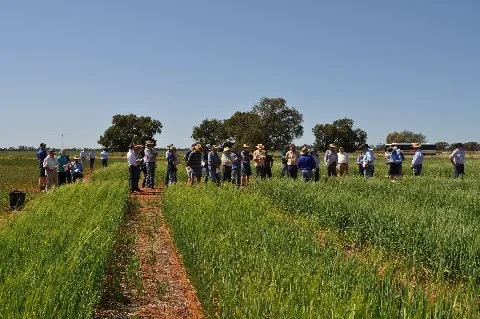
Factors that Influence Soil Carbon Levels
Fast facts
Soil characteristics, climate and management practices can alter the amount of carbon in soil
Soil carbon is a balance between inputs (such as plant shoots, roots and leaves) and outputs (such as decomposition and conversion into carbon dioxide)
Regardless of its potential, the amount of carbon a soil can actually hold is limited by factors such as rainfall, temperature and sunlight, and can be reduced further due to factors such as low nutrient availability, weed growth and disease.
The amount of carbon in a soil is dependent on the characteristics of the soil and the balance between
inputs and losses
How much carbon can a soil hold
Factors which affect soil carbon losses
Factors which affect soil carbon inputs
Actual soil carbon levels
Many factors, such as rainfall, temperature, vegetation and soil type determine the amount of carbon in
soil.
Some of these factors are fixed characteristics of the soil, some are determined by the climate and
some can be influenced by management practices.
How much carbon can a soil hold – how big is your bucket?
The amount of carbon in a soil can be thought of as a leaking bucket that constantly needs topping up.
The size of the bucket represents the total amount of carbon the soil could potentially hold.
Factors such as clay content, soil depth and soil density will affect the size of the bucket, for example,
the bucket will be smaller for sand than clay soil. Management practices can not influence the size of
the bucket.
Factors which affect soil carbon losses – how leaky is your bucket?
Losses of carbon from soil result from decomposition and conversion of carbon in plant residues and
soil organic materials into carbon dioxide. Processes that accelerate decomposition open the losses
tap further.
Many factors, such as rainfall, temperature, vegetation and soil type determine the amount of carbon in
soil.
The rate of loss is determined by:
type of plant and animal matter entering the soil
climate conditions (rainfall, temperature, sunlight)
soil clay content
Some management practices which reduce carbon inputs and/or increase the decomposition of soil
organic matter can also influence carbon losses.
These include:
fallowing
cultivation
stubble burning or removal
overgrazing
Factors which affect soil carbon inputs – how much are you re-filling your bucket?
Soil organic carbon inputs are controlled by the type and amount of plant and animal matter being
added to the soil. Any practice that enhances productivity and the return of plant residues (shoots and
roots) to the soil opens the input tap, re-filling the bucket and the amount of carbon in the soil.
The majority of carbon enters the soil as plant residues.
Fire can also contribute by converting plant dry matter into charcoal which enters the recalcitrant
fraction (see Soil carbon: the basics). However, fire itself can lead to carbon losses through release of
carbon dioxide.
Soil organic carbon inputs are controlled by the type and amount of plant and animal matter being
added to the soil. Any practice that enhances productivity and the return of plant residues (shoots and
roots) to the soil opens the input tap, re-filling the bucket and the amount of carbon in the soil.
The majority of carbon enters the soil as plant residues.
Fire can also contribute by converting plant dry matter into charcoal which enters the recalcitrant
fraction (see Soil carbon: the basics). However, fire itself can lead to carbon losses through release of
carbon dioxide.
Plant residue, and thus soil carbon inputs are mainly affected by the:
type of plants being grown
amount of dry matter the plants accumulate over the growing season
environmental factors which govern plant production
A variety of management practices can increase soil carbon levels by increasing inputs.
In theory, maximising productivity also maximises returns of organic residues to the soil. Practices thatincrease productivity include:
fertiliser application
improved rotations
improved cultivators
irrigation
crop intensification
Reduced tillage or no-tillage management practices can also increase soil carbon levels as carbon in
the crop stubble is left to return to the soil.
Soil carbon can also be topped-up by direct application of organic materials to the soil. Examples of
these materials include: manure, plant debris, composts, and biosolids, with biochar attracting interest
for its potential in this area.
Although significant changes can occur quickly when moving across extreme differences in
management practices, it is important to note that often decades of constant management are required
to define the ultimate soil organic carbon content that may be reached.
Actual soil carbon levels
Even though a soil may have the potential to store a certain amount of carbon, it is unlikely that this will
be the actual amount that is ever found in the soil.
Limiting factors (such as the availability of water) will affect the attainable amount of soil carbon. While
decreased productivity due to reducing factors (such as low nutrient availability, weed growth, disease,
or subsoil constraints) will further lower soil carbon levels.
Once all these factors have been taken into account the actual soil carbon level which could possibly
be achieved with optimal carbon inputs can be determined.
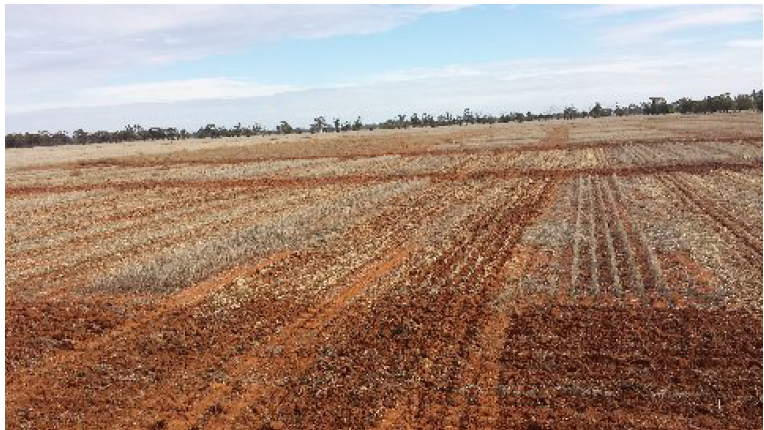
Soil Carbon, The Basics
Fast facts
Soil carbon is part of the soil organic matter which is composed of decaying plant and animal matter.
CSIRO scientists have identified four biologically significant types or fractions of soil organic carbon: crop residues, particulate organic carbon, humus and recalcitrant organic carbon.
Each fraction has different functions due to the relative stability and biological availability of the carbon.
Factors such as water availability, soil type and management practices can influence the amount of carbon stored in the different fractions.
Soil organic carbon is a complex and varied mixture of materials and makes up a small but
vital part of all soils.
What is soil carbon?
Different types of soil carbon
Key functions of the different types of soil carbon
Movement between soil carbon fractions
What is soil carbon ?
Soil carbon, or soil organic carbon (SOC) as it is more accurately known, is the carbon
stored within soil.
It is part of the soil organic matter (SOM), which includes other important elements such as
calcium, hydrogen, oxygen, and nitrogen.
Soil organic matter is made up of plant and animal materials in various stages of decay.
Un-decomposed materials on the surface of the soil, such as leaf litter, are not part of the
organic matter until they start to decompose.
Different types of soil carbon
However, although determining the amount of soil organic carbon in soil is important for
understanding soil health, knowing the type of organic carbon present is also important as
this can greatly impact soil productivity.
“We have established that the amount of each organic carbon fraction varies significantly
across soil types and some fractions can be altered by management practices”
Dr Jeff Baldock, CSIRO Land and Water
CSIRO scientist, Dr Jeff Baldock and his team have identified four biologically significanttypes or fractions of soil organic carbon:
crop residues – shoot and root residues less than 2 mm found in the soil and on the soil surface .
Particulate organic carbon – individual pieces of plant debris that are smaller than 2 mm but larger than 0.053 mm.
humus – decomposed materials less than 0.053 mm that are dominated by molecules stuck to soil minerals
Recalcitrant organic carbon – this is biologically stable; typically in the form of charcoal.
The different types of soil organic carbon not only differ in size but are also composed of
different materials with different chemical and physical properties and different
decomposition times.
Key functions of the different types of soil carbon
Each fraction of soil carbon has different functions, most of these are due to the relative
stability and biological availability of each fraction:
Crop residues
readily broken down and provide energy to soil biological processes
Particulate organic carbon
broken down relatively quickly but more slowly than crop residues
important for soil structure, energy for biological processes and provision of nutrients
Humus
Plays a role in all key soil functions
Particularly important in the provision of nutrients – for example the majority of available soil nitrogen derived from soil organic matter comes from the humus fraction.
Recalcitrant organic carbon
Is usually charcoal – a product of burning carbon-rich materials. As ‘biochar’, it is attracting interest as both a carbon sink and, possibly, a source of soil benefits.
Decomposes very slowly and is therefore unavailable for use by microorganisms
Many Australian soils have high levels of charcoal from millennia of burning.
The amount of each type of organic carbon in Australian agricultural soils varies significantly.
In rainforests or good soils organic carbon can be >10 per cent, while in many poorer soils
or soils which are heavily exploited, levels are typically <1 per cent.
The proportion of some fractions can also vary due to management practices. This is
important as different fractions decompose at different rates and contain different quantities
of nutrients, which will have an impact on the health and productivity of the soil.
Balancing carbon inputs and outputs
The amount of organic carbon in soil is a balance between the build-up which comes from inputs of new plant and animal material and the constant losses where the carbon is decomposed and the constituents separate to mineral nutrients and gases, or are washed or leached away.
Carbon levels build up where water, nutrients and sunlight are plentiful.
Carbon is lost where:
Microbial activity is high (such as in warm, moist environments).
Where there are fallow periods with no plant inputs.
Soil Microbes (The Multiple Benefits of Soil Carbon)
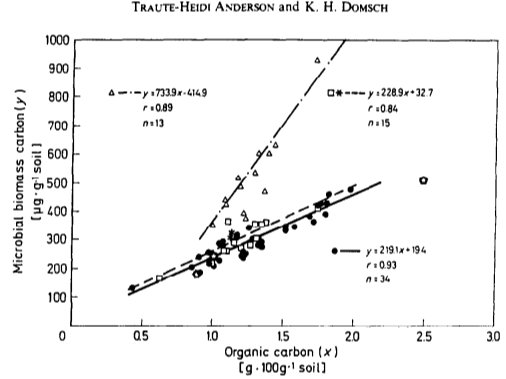
To take a look at how soil carbon has influenced the microbial population I have decided to analyse a paper from Great Britain. The paper looks at two separate cropping systems (Continuous and rotational cropping) and they test how the microbes from these two separate systems react with to an introduction of soil carbon into the system.
Data Sourced from The department of soil biology
Continuous Cropping
Rotational Cropping
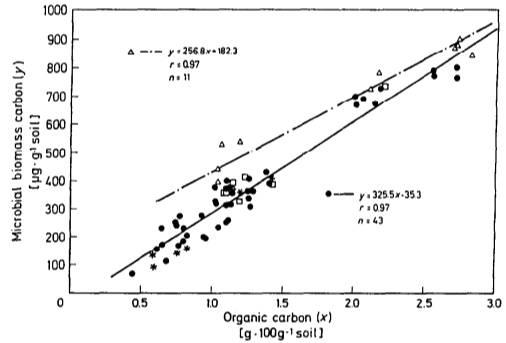
Fig. 2 & 3: Correlation between microbial-C and organic-C in soils under continuous cropping and crop rotations.
Regression lines correspond to the following amendments: Black circle: mineral, Triangle: green manure Plots with a square are not included in the regression. Sites I I and 25 are omitted because of their high carbon contents, see text.
The above graphs show the microbial populations increasing as the organic carbon within the soil profile increases. Ideally we would like to see a linear relationship between organic carbon and microbial biomass, which is shown in the rotational cropping graph but not the continuous cropping graph. So lets look at why the rotational cropping system is converting organic carbon to microbial biomass more efficiently than the continuous cropping system.

Image sourced from Microbe Farmer
The microbial population within the rotational cropping system have evolved in a way that allows them to break down a variety of different types of organic carbon. Whereas the microbes within the continuous cropping system have only adapted to one type of carbon source. A good analogy for this scenario is bringing prime lambs onto a grain ration. If the lambs have been grazing pastures then the microbial population is optimised to break down fibrous plant material. So a sudden influx of grain may prove fatal to the animal. So when it comes to storing soil carbon it may prove beneficial to adopt mixed farming systems in order to provide a larger amount of diversity within the soil microbial population.
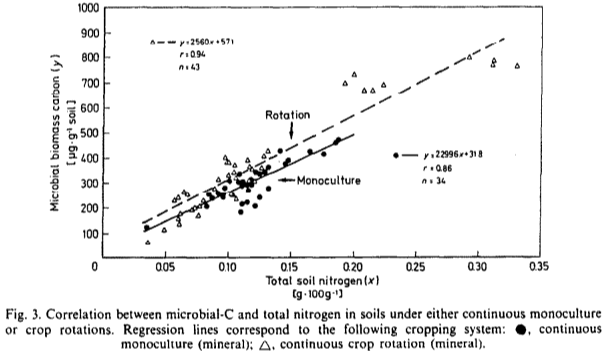
So now that we know that microbes in mixed cropping systems are capable of converting soil carbon to microbial biomass a lot more effieciently than microbes in continuous cropping systems. The above graph reinforces the benefits of microbes under mixed cropping systems with the two plots been compared in the same graph. As you can see the mirobes in the mixed cropping system are responding much better to the nitrogen source than the microbes in the continuous cropping system.
We have looked at how we can modify our farming systems so that we can maximise microbial biomass in the additions of soil carbon. Then again what do fat little microbes really mean for Australian farmers. To answer the question im going to refer to a nice little factsheet that was produced by the CSIRO. The CSIRO outlines two main benefits of increasing the microbial biomass of soils. The first benefit was that the soils were retaining 64% of the nitrogen additions against leaching. The second benefit is that the rate of mineralised nitrogen increased by 50% from 20kg/ha/year to 30kg/ha/year. So when it comes to nitrogen budgeting for your up and coming crops those fat little microbes may prove to be one of your biggest allies.
Hopefully this information has proved helpfull and if you have any questions and quaries regarding the research than feel free to add them to the comments section below. Also for regular updates make sure you follow our facebook and twitter feeds.
This is an extension article produced for the action on the ground project. Results depicted in this article have not been sourced from the project itself they are added for educational tools only. All information sources have been referenced accordingly.
Soil Structure (The Multiple Benefits of Soil Carbon)
Soil carbon in the past has been known for its nutrient properties but little did we know that there was a wide array of benefits that are derived from soil carbon. So to kick things off we will check out a handy piece of research done by the GRDC.
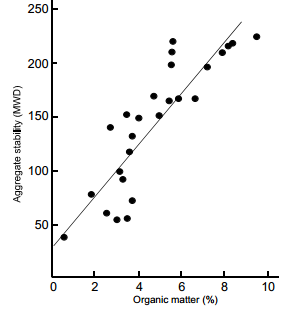
Figure 1: Relationship between aggregate stability and organic matter content for 26 soils (redrawn from
Chaney and Swift, 1984).
The above graph shows the impact of soil organic matter on the mean weight diametre (MWD) of soil aggregates. The above graph shows a possitive linear relationship between soil organic matter and aggregate stability. So lets look at how exactly the organic matter is so effective when it comes to improving the structure of Australian soils. Their are three main organic binding agents that are responsible for the formation of soil aggregates.
Temporary binding agents
This fraction includes root material, VAM hyphae as well as ectomycorrhizal fungi and several pieces of saprophytic fungi (Tisdall 1994).
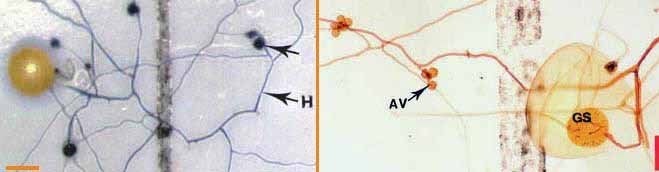
Image sourced from Mycorhizas
What you can see above is an image of a VAM hyphae that has produced spores. As you can see the hyphae produce a dense fibrous network and its this very network thats responsible for holding soil aggregates together. Also dont get nervous when you hear the word fungi because VAM is beneficial to your crops. These hyphae tap into the plant roots and begin to act as an extended root system for the plant. As these hyphaes spread throughout the soil they begin to source nutrients that the plant couldnt otherwise reach. So to put it simply it may be beneficial to adopt management practices that promotes the growth of these dense networks within the soil.
Transient binding agents
Transient binding agents include polysaccharides that are produced by microbial activity and the secretions by roots called root exudates. It has been proven that the additions of plant and animal residues will likely increase the production of plant polysaccharides although it should be noted that even though there may be an abundance of polysaccharides binding soils together these polysaccharides are also broken down at a rapid rate within soils. You could think of soil microbes as small children they are always in search of a sugar source and these polysachrides are the equivalent to finding a cookie jar so its understandable why they dont last long within the soils. Although they are worth noting as they do contribute a great deal to aggregate formation.
Persistent binding agents
The persistent binding agents mostly consist of metal-OM, which is sourced from resistant fragments of roots, hyphae and bacterial cells. Organic material is quite often stabilised by metals such as aluminium and iron. These structures aren’t normally affected by management practices.
Hopefully that sums up the structural benefits of soil organic carbon and how your management practices will influence these structures. If you have any questions feel free to add them to the comments section below and CWFS now has a twitter profile as well as a facebook profile so feel free to follow our updates from there.
References
Peer reviewed paper by ACIAR
functions of organic matter GRDC
Leco Analysis to Measure Soil Carbon
For some time now there has been a great deal of debate around soil carbon and what farming methods are proved to be the most effective when it comes to increasing the carbon levels of the soil. This has resulted in CWFS forming a project to find out which farming practice is best for storing soil carbon as well as how each farming practice is impacting soil health.
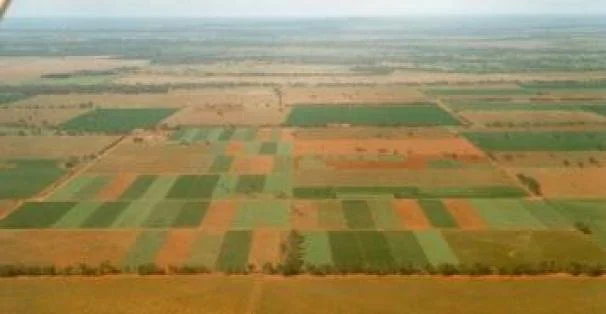
How will we do it: CWFS has set an experiment to demonstrate the effects of four separate farming systems. These farming systems are traditional cropping and grazing, reduced tillage cropping-grazing mixed, continuous cropping rotation and a perennial pasture system for all you sheep graziers out there.
The next step is to analyse the historical carbon levels as the farm systems trial progressed over a 10 year period. The samples were taken in 2004 (5 years) and 2008 (10 years) after the start of the project. The samples taken were 0-10cm and 10-30cm soil cores.
To determine the current soil carbon levels we will take a 0-30cm core and separate the core into 4 separate samples (0-10, 5-10, 10-20, 20-30cm) to get a good idea of how the carbon is distributed throughout the profile. Ten of these samples will be taken from each phase.
All of the freshly collected samples are the weighed and air dried, typically at 40 degrees Celsius for a minimum of 48 hours and then the sample mass is recorded.
The soil is then passed through a 2mm sieve and the mass of the retained material is recorded. A jaw crusher is occasionally used to deal with some of the more persistent aggregates that decide not to pass through.
A sample of 500 grams of less than 2mm soil material is further grinded down and sent away for a LECO analysis.
The remaining sample needs to be oven dried at 105 degrees to determine the oven soil dry weight. This is an important part in calculating bulk density.
The results from this procedure will allow us to determine which farming practises have been the best at storing soil carbon as well as maintaining soil health.
Soil Carbon CWFS AOG Results Summary

A long term farming systems trial was conducted at Condobolin in order to analyse the impacts of current farming systems on soil nutrients and soil carbon. The CWFS Systems Comparison Trial (commenced in 1998) was spread over the 160 ha trial site at Condobolin. The 160 hectare site was further broken down into four main replicate blocks. Each block had four different farming systems on trial.
These farming systems include:
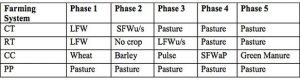
Traditional farming system (CT)
The CT represents a mixed farming system that uses conventional tillage with a pasture phase and grazing.
This system was set up to reflect what many growers in the region were using on their own properties. The crops in rotation on the system included long fallow wheat (LFW), short fallow wheat undersown with a pasture combination (SFWu/s) and a grazed pasture. The sown pasture contained annual medics and lucerne.
Reduced tillage with livestock (RT)
The RT represented another mixed farming system using a rotation of (LFW) long fallow wheat under sown with a pasture combination (LFWu/s), grazed pasture and a period of rest between wheat crops. During the rest period stubble was maintained and weeds were controlled by grazing and herbicide applications (in August). The sown pasture contained annual medics and lucerne.
Zero-till with no livestock (CC)
The CC represented a continuous cropping rotation that was dependent on herbicide application for weed control.
This system was chosen to represent the intensified cropping systems in the Central West (NSW). The crops in rotation were wheat, barley, a pulse crop, SFWaP (aP – after pulse) and a green manure crop (Pulse). Initially the pulse crop was sown as canola and then converted to a pulse. After a number of years the pulse crop was not harvested and the pulse and green manure crops were essentially the same treatment.
Perennial Pasture (PP)
This farming system was divided in 12 equal segments and was rotationally grazed. Decisions regarding stocking rates and grazing pressure were made based on seasonal climatic conditions.
The pasture established in the PP system was a combination of lucerne, clover and medics. After an initial period of grazing, these treatments were only stocked periodically and the rotational treatments were not kept in place.
Results
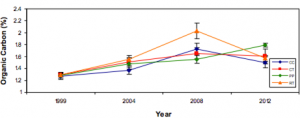
Soil organic carbon increased across all systems until 2008. In years from 2008 to 2012 there was a steep decline in soil organic carbon across all systems except for the pasture phase.
During the CC treatment the phosphorous levels increased linearly at a rate of 1.8mg/kg per year of crop. This was due to the constant applications of phosphorous based fertilisers during the cropping periods.
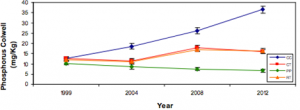
An interesting point to make is that the organic carbon within pasture system increased at a higher rate than the decrease in available phosphorous, which is largely inorganic. This means that phosphorous must have been provided from other sources. The only other alternative would be that soil organic carbon and plant available phosphorous were relatively independent of one another.
The continuous cropping system exhibited soil degradation over the length of the experiment. The continuous cropping resulted in an increase in the availability of exchangeable aluminium ( Al+3 ) and a reduction in the availability of calcium carbonate (Ca+2 ).
Sulphur showed consistently lower levels during the pasture phases when compared to the cropping phases.
Conclusion
The results have shown that under continuous cropping systems even though there is an increase in soil organic carbon as well as plant available phosphorous the soil health will still decline due to a reduction in Ph as a consequence of the continuous cropping phases.
Therefore in order to maximise the amount of carbon stored within the soil without negatively impacting the soils health the zero till system with no livestock and the traditional farming system proved to be the most effective farming systems.
You can download the full paper by clicking the link below